Give your AI agents the healthcare knowledge they're missing.
Amandil tells your AI how healthcare works, process by process and rule by rule, with the source behind every answer.
- ~2,000payer & provider processes
- ~2,500regulations linked to them
- 9,000+hospitals with CMS performance data
- 22operational domains
Ask about a health system. Get all of it, through one connection.
Ask in plain language. Amandil returns the whole health system at once: every hospital, and every figure with its reporting period.
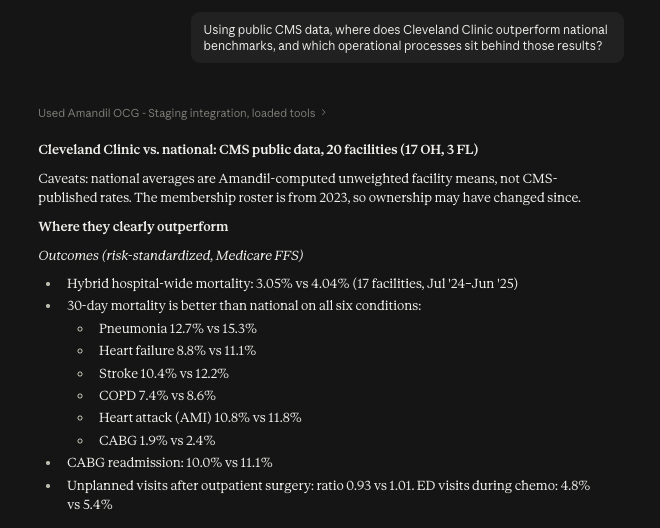
- The whole system. Twenty hospitals in two states, not just the flagship.
- Every figure dated. Each number carries its measurement period and how many hospitals reported it.
- One connection. The work of finding, downloading and joining public files is already done.
- Its limits stated. It says what the data can't show.
Your platform knows your company. Amandil adds how healthcare works.
Data platforms build context from your own tables and transactions. Amandil supplies the industry model: healthcare's processes, rules and how they connect.
- The imaging claim denial rate rose from 4% to 9%.
- Many of the denied claims show authorization issues.
- Patients are waiting longer between booking and their scans.
- An authorization may be valid only for specific service dates.
- A scheduling delay can push a scan beyond those dates.
- That can turn a scheduling problem into a payment problem.
Illustrative example with fictional data. Product names belong to their owners and do not imply affiliation.
An agent working in healthcare needs both. Amandil supplies healthcare context. Your connected systems supply the company-specific evidence.
For anyone putting AI to work in healthcare.
Health systems
The agents you build start from how each of your hospitals actually performs, not from a blank page.
See what you get
- Each hospital compared with national CMS measures, with the measurement period on every number
- A ranked view of where AI and automation fit across your operation
- The processes and rules your agents need, in one connection
Payers
Agents that work prior authorization and denials from the actual rule and process, with a source for every step.
See what you get
- Payer operations mapped process by process, from claims to utilization management
- The regulations behind each process, linked to where they apply
- The same connection for the agents your teams build
Consultancies
Weeks of discovery become a branded analysis. Your team arrives already knowing the client's operation.
See what you get
- An account brief on a named health system or health plan before the first meeting
- Materials for executive working sessions, built from public benchmarks
- Documents and decks produced in your own templates
Platforms & cloud
Healthcare knowledge for the agents your customers build on your platform, and for the sellers who call on them.
See what you get
- Account playbooks for your sellers, from first meeting to renewal
- Healthcare knowledge for the AI agents your customers build on your platform
- AWS Marketplace and Databricks Marketplace listings, coming soon
Your agent could rebuild this on every question. It shouldn't have to.
No downloading, cleaning and joining public files every time someone asks a question.
Production agents need consistent, sourced figures, not a different method on every run.
Every hospital in a health system rolled up, with the sites behind each number.
Healthcare is first. Every regulated industry needs a model of how it runs.

Sean Turner, Founder & CEO. Previously Chief Data Officer at Banner Health and System SVP of Data & Analytics at CommonSpirit Health. About →
What is Amandil?
Amandil is a working model of how the healthcare industry runs: the processes health systems and payers carry out, the regulations and standards behind each process, and public performance data for hospitals and health systems. AI agents and assistants connect to it so they answer from how healthcare actually works, with a source behind every answer. It was founded in 2026 by Sean Turner, formerly Chief Data Officer at Banner Health.
What is the Operational Context Graph?
The Operational Context Graph, or OCG, is the name of Amandil's model. It links each healthcare process to the regulations that govern it, the measures that track it and the organizations that perform it, in a form AI tools can query.
How does Amandil connect to our AI?
Through MCP, the standard way AI assistants and agents connect to outside tools, or through a REST API. Claude, Cursor and most agent frameworks support it. There's no data pipeline to build.
Do you need our data?
No. Amandil is built from public sources: federal and state regulations, CMS data, industry standards and public announcements. We don't ingest patient data or connect to your systems. Agents you build can combine Amandil with your own data inside your environment.
Can't our AI just search for this?
Yes. A capable assistant with web access and code tools can pull public files and work it out, and its method changes from run to run. Amandil does that work ahead of time and returns it through one connection, the same way each time, so agents running in production don't have to.
How is this different from enterprise ontology products?
They're two sides of the same coin. AWS Context, Databricks Genie Ontology, Google Cloud's Knowledge Catalog, Microsoft Fabric IQ, Palantir's Ontology and Snowflake's Semantic Views each map your company from your own data. Amandil maps the industry your company operates in. An agent working in healthcare needs both.
Where can we buy it?
Directly from us today. AWS Marketplace and Databricks Marketplace listings are coming soon.
See what your AI can do when it knows healthcare.
Book a conversation. Tell us who you are and what you're working on. We reply within 48 hours.
Prefer email? hello@amandil.ai